
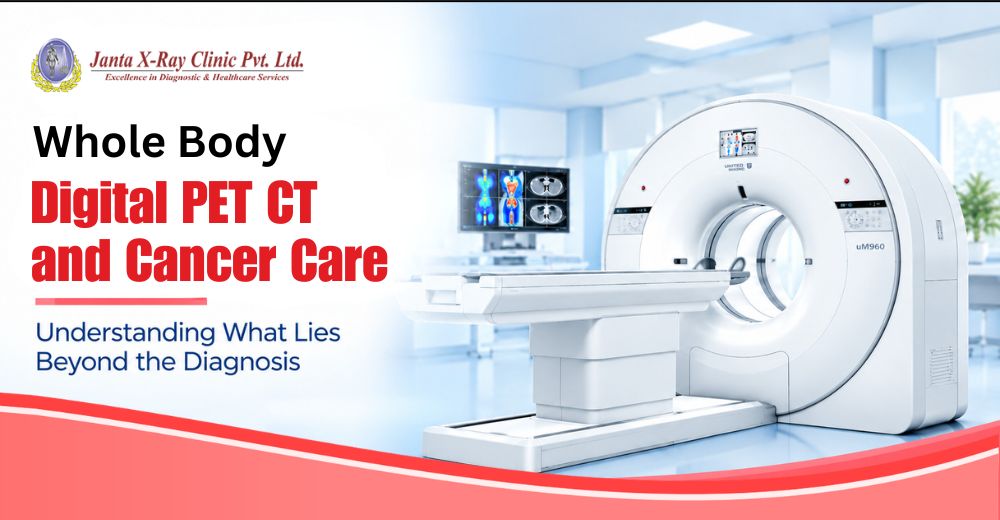
Whole Body Digital PET CT and Cancer Care | Understanding What Lies Beyond the Diagnosis
A cancer diagnosis brings several questions, and not all of them can be answered by identifying a tumour alone. Where exactly is the disease located? Has it affected other parts of the body? Is the treatment producing the expected response? These questions can influence the next steps in medical care.
This is where Whole Body Digital PET CT becomes particularly relevant. By combining information about tissue activity with detailed anatomical imaging, PET CT helps doctors assess certain cancers more comprehensively.
As conversations around Lung Cancer Awareness Month, Pancreatic Cancer Awareness Month, Stomach Cancer Awareness Month, Prostate Cancer Awareness and National Cancer Awareness Day gain attention, understanding the role of advanced cancer imaging becomes equally important.
What Makes Whole Body Digital PET CT Important in Cancer Imaging?
Unlike a conventional CT scan, which primarily provides detailed images of internal structures, PET CT combines two different types of information.
The PET component examines how tissues absorb a small amount of radioactive tracer, while the CT component helps identify their anatomical location.
Together, these findings can help doctors investigate suspicious areas, assess the extent of certain cancers and evaluate treatment response.
Digital PET technology uses advanced detectors to capture signals generated during scanning. Depending on the system and examination protocol, this can support improved image quality and efficient imaging.
However, PET CT is not recommended for every patient or every type of cancer. Its usefulness depends on the clinical situation and the tracer selected.
Lung Cancer and the Importance of Understanding Disease Extent
When lung cancer is diagnosed, understanding whether it remains confined to the lungs or has affected lymph nodes or distant organs is essential for treatment planning.
FDG PET CT for lung cancer can help doctors evaluate disease extent and investigate findings that may influence decisions about surgery, radiation or other treatments.
It may also be recommended when conventional imaging raises concerns about recurrence or when treatment response needs further assessment.
Pancreatic Cancer and the Need for Comprehensive Assessment
Pancreatic cancer can present considerable challenges because symptoms may be difficult to distinguish from other digestive conditions.
Contrast enhanced CT and MRI remain important investigations for evaluating pancreatic tumours.
In selected patients, PET CT for pancreatic cancer may provide additional information about possible disease spread or clarify findings that remain uncertain after other investigations.
The objective is not simply to obtain another scan, but to answer a specific clinical question that could influence treatment decisions.
Stomach Cancer and Looking Beyond the Primary Tumour
In stomach cancer, doctors need to understand the location and extent of the disease before deciding on appropriate management.
Endoscopy, biopsy and CT imaging remain central to assessment.
For certain patients, PET CT for stomach cancer may offer supplementary information, particularly when investigating possible disease spread or recurrence.
Not all stomach cancers show significant activity on FDG PET imaging, making careful selection of patients particularly important.
Prostate Cancer and the Importance of the Right PET CT Tracer
Prostate cancer imaging requires a different consideration.
While FDG PET CT is useful in several cancers, PSMA PET CT is often more relevant for selected patients with prostate cancer.
PSMA imaging targets a protein commonly expressed by prostate cancer cells and can help assess disease spread or investigate recurrence in appropriate clinical circumstances.
This distinction highlights why choosing the correct investigation matters as much as choosing advanced imaging technology.
Why the Timing of a PET CT Scan Matters
A scan performed at the appropriate stage of cancer care can provide information that influences medical decisions.
Whether doctors are assessing disease extent before treatment, evaluating response after therapy or investigating suspected recurrence, timing is important.
Scanning too soon after certain treatments may produce findings influenced by inflammation rather than active cancer.
Equally, postponing a medically recommended investigation without discussing it with the treating doctor may delay important decisions.
The priority should always be the right investigation, for the right clinical reason, at the right time.
Whole Body Digital PET CT at Janta X-Ray Clinic Pvt. Ltd., Tilak Nagar
Access to advanced imaging technology is an important consideration for patients undergoing cancer evaluation.
Located at 4A/16, Tilak Nagar, New Delhi 110018, Janta X-Ray Clinic Pvt. Ltd. offers Whole Body Digital PET CT imaging, bringing this advanced diagnostic facility to West Delhi.
Our commitment is to make sophisticated diagnostic technology accessible while recognising the importance of careful imaging procedures, accurate interpretation and responsible patient care.
We believe the true value of advanced diagnostics lies not merely in the technology itself, but in the clinical information it provides to treating doctors.
Because in cancer care, understanding the extent and behaviour of disease can make a meaningful difference to the decisions that follow.
For doctor recommended Whole Body Digital PET CT investigations, connect with Janta X-Ray Clinic Pvt. Ltd. in Tilak Nagar, New Delhi.
Website www.jantaxray.in
Contact: +91-9990019117 or 011-49114911
Frequently Asked Questions
Question: If a biopsy has already confirmed cancer, why might a doctor still recommend a PET CT scan?
Answer: A biopsy identifies cancer in the sampled tissue, but it does not necessarily establish how far the disease has spread. PET CT may help assess disease extent and provide additional information for treatment planning in certain cancers.
Question: Can a Whole Body Digital PET CT scan identify every cancer present in the body?
Answer: No. Some cancers show limited uptake of commonly used PET tracers, and very small lesions may not be visible. PET CT findings must be interpreted alongside clinical history, other imaging and pathology results.
Question: Is the same PET CT scan used for lung cancer and prostate cancer?
Answer: Not necessarily. FDG PET CT is commonly used in selected lung cancer cases, while PSMA PET CT is often more appropriate for specific prostate cancer indications. The tracer and protocol depend on the clinical question.
Question: If a PET CT report shows increased metabolic activity, does that always mean cancer?
Answer: No. Infection, inflammation and certain normal physiological processes can also produce increased tracer uptake. Doctors interpret these findings alongside the patient's medical history and other investigations.
Question: Can PET CT help determine whether chemotherapy is working?
Answer: In selected cancers, PET CT can help assess changes in tumour metabolic activity following treatment. However, the timing of the scan and the type of cancer are important, and PET CT is not always the preferred response assessment method.
Question: Why might a doctor advise waiting before undergoing PET CT after radiation or surgery?
Answer: Treatment related inflammation and tissue healing can influence PET CT findings. Waiting for an appropriate interval may improve the reliability of the assessment. The recommended timing depends on the treatment and clinical circumstances.
Question: Can patients book a PET CT scan without discussing it with their oncologist?
Answer: Patients should consult their treating doctor before scheduling a PET CT scan. The medical indication, tracer selection, previous reports and treatment history help determine whether the examination is appropriate.
Question: Where can patients enquire about Whole Body Digital PET CT in West Delhi?
Answer: Patients can contact Janta X-Ray Clinic Pvt. Ltd., located at 4A/16, Tilak Nagar, New Delhi 110018, to enquire about its Whole Body Digital PET CT facility, preparation requirements and appointment arrangements.








Comments List