
When Swollen Lymph Nodes Were Treated as Tuberculosis Until FNAC Revealed Lymphoma
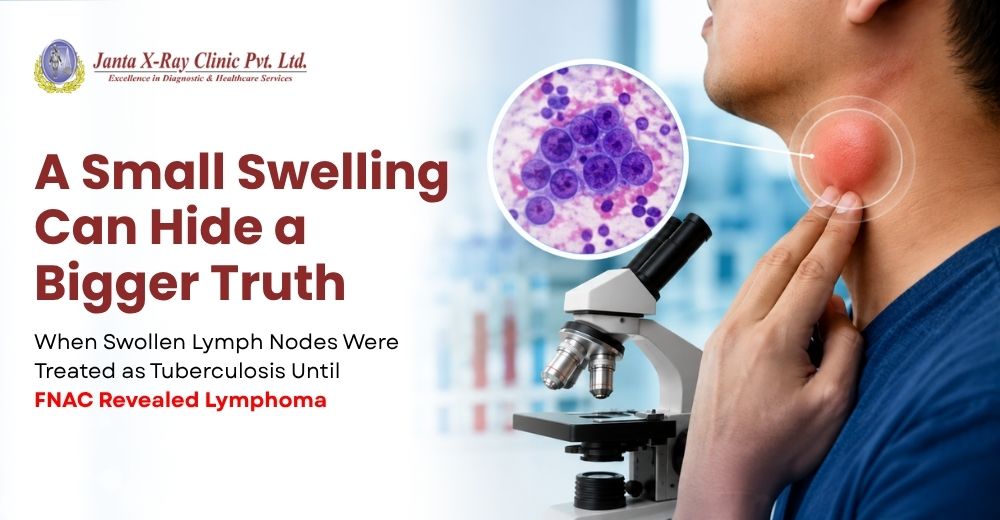
He Came Looking for Reassurance. The Microscope Told Another Story.
Some patients enter a laboratory carrying more than prescriptions and previous reports.
They carry fear.
Confusion.
And the silent hope that someone will finally tell them what is really wrong.
A middle aged man walked into Janta Xray Clinic, Tilak Nagar with persistent swollen lymph nodes in his neck. The swelling had been there for weeks. His face reflected exhaustion, but not just physical exhaustion. There was emotional fatigue too. The kind that slowly builds when treatment begins, yet recovery never truly follows.
He had already consulted elsewhere and had been started on empirical Anti Tubercular Therapy based on clinical suspicion.
In India, tuberculosis remains one of the most commonly suspected causes of cervical lymph node swelling. The diagnosis often feels almost automatic. Patients trust the process because tuberculosis is common, the symptoms appear familiar, and early treatment is considered important.
So he trusted it too.
He took the medicines.
He waited for relief.
But the swelling stayed.
Weeks passed.
The medicines continued.
The doubt quietly grew.
His family became increasingly worried. Deep down, even he felt something was not right. That uncertainty eventually brought him to our diagnostic center. He did not come searching for a new diagnosis.
He came looking for reassurance.
What happened next changed the course of his entire treatment journey.
The Danger of Treating Assumptions Instead of Diagnoses
As pathologists, we are trained to notice what others may overlook.
On examination, the cervical lymph nodes were enlarged, firm, and multiple. Tuberculosis was certainly one possibility, but the clinical picture raised another important question:
What if this is something else?
Instead of continuing treatment blindly, FNAC or Fine Needle Aspiration Cytology was advised by the clinician.
FNAC is one of the most valuable frontline diagnostic procedures in modern pathology. It is quick, minimally invasive, cost effective, and capable of providing crucial diagnostic direction through microscopic evaluation of aspirated cells.
In many cases involving persistent neck swelling or enlarged cervical lymph nodes, FNAC helps guide timely diagnosis and treatment decisions.
Yet despite its clinical importance, FNAC is often underestimated.
Sometimes, a few carefully collected cells can reveal what weeks of assumptions cannot.
And in this case, those cells spoke with remarkable clarity.
A Few Cells Under the Microscope Changed Everything
When the smears were examined under the microscope, the findings did not support tuberculosis.
There were no epithelioid granulomas.
No caseous necrosis.
No classical cytological features suggestive of tubercular lymphadenitis.
Instead, the slides revealed atypical lymphoid cells.
Abnormal.
Suspicious.
Concerning.
The findings immediately raised suspicion for lymphoma.
At that moment, the patient’s treatment changed direction.
Further evaluation and confirmatory investigations later established the diagnosis of lymphoma.
The disease being treated for weeks was never tuberculosis.
When Relief and Fear Arrive Together
One of the most difficult truths in medicine is that serious diseases often hide behind ordinary symptoms.
For weeks, this patient believed he was battling an infection while the real disease silently progressed underneath.
He was following treatment.
Waiting for improvement.
Holding onto hope.
Without knowing that the actual condition required a completely different therapeutic approach.
When the diagnosis was finally explained, the emotional response inside the room was impossible to ignore.
There was shock.
There was fear.
But there was also relief.
Relief that the uncertainty had finally ended.
Relief that the real problem had finally been identified.
A correct diagnosis, even when emotionally difficult, gives patients something powerful: direction.
Because only when the disease is identified accurately can the right treatment truly begin.
Persistent lymph node enlargement should always be properly evaluated before treatment is continued empirically. FNAC plays an important role in guiding accurate diagnosis and further management.
— Dr. Priyanka Anand

Why FNAC Remains One of Pathology’s Most Powerful Tools
FNAC continues to play a crucial role in the early diagnosis of lymph node diseases and unexplained swellings.
In cases involving swollen lymph nodes in the neck, FNAC often helps differentiate between:
- Tuberculosis
- Reactive lymphadenitis
- Lymphoma
- Metastatic malignancy
- Other infectious and inflammatory conditions
The procedure is fast, minimally invasive, highly informative, and often prevents unnecessary delays in treatment.
More importantly, it protects patients from the emotional and physical burden of incorrect diagnosis.
This case serves as an important reminder of one fundamental medical principle:
Treatment should follow diagnosis, not assumptions.
Behind Every Slide Is a Human Story
Not every enlarged lymph node is tuberculosis.
Not every common presentation has a common diagnosis.
And sometimes, a few carefully examined cells under a microscope can completely alter a patient’s future.
As pathologists, we may not always remain visible in a patient’s long journey, but our observations often become the turning point that changes everything.
This case was a powerful reminder that accurate diagnosis is not merely a laboratory conclusion. It is the foundation of timely treatment, appropriate care, and renewed hope.
At Janta Xray Clinic, every sample is approached with attention, precision, and responsibility because behind every slide is a human story waiting for the right answer.
What Causes Swollen Lymph Nodes in the Neck?
Swollen lymph nodes in the neck may occur due to infections, tuberculosis, inflammatory conditions, reactive lymphadenitis, autoimmune disorders, or serious illnesses like lymphoma. When the swelling persists for several weeks or continues to increase in size, proper medical evaluation becomes important to identify the underlying cause accurately.
Frequently Asked Questions
Can lymphoma be mistaken for tuberculosis?
Yes. In countries where tuberculosis is common, enlarged cervical lymph nodes are often clinically suspected to be tubercular in origin. However, lymphoma and tuberculosis can sometimes present with similar symptoms, making pathological evaluation extremely important for accurate diagnosis.
What is FNAC and why is it important?
FNAC or Fine Needle Aspiration Cytology is a minimally invasive diagnostic procedure used to examine cells collected from swellings or lymph nodes. It helps doctors differentiate between infections, inflammatory conditions, and malignancies like lymphoma.
Is FNAC enough to diagnose lymphoma?
FNAC provides valuable preliminary diagnostic information and often raises strong suspicion for lymphoma. However, additional investigations such as biopsy, immunohistochemistry, and imaging studies may be required for complete classification and confirmation.
What causes swollen lymph nodes in the neck?
Swollen lymph nodes in the neck may occur due to infections, tuberculosis, reactive lymphadenitis, autoimmune conditions, metastatic cancer, or lymphoma. Persistent swelling should always be medically evaluated.
When should persistent neck swelling be investigated?
Any neck swelling that persists for several weeks, increases in size, or does not improve with treatment should be properly investigated. Early diagnosis plays a critical role in identifying serious underlying conditions at the right time.
Can FNAC help avoid incorrect treatment?
Yes. FNAC often helps prevent unnecessary or inappropriate treatment by identifying the actual underlying disease process. Accurate pathology ensures that treatment decisions are based on diagnosis rather than assumptions.


.png)
.jpg)




.png)
Comments List